Ikigai Is Not What the Internet Thinks It Is
How We Grow Into the Things That Give Life Meaning
Mieko Kamiya spent part of her career as a psychiatrist at Nagashima Aiseien, a sanatorium for people with Hansen’s disease, thinking about a difficult question: what makes a life feel worth living when illness, loss, guilt, disappointed hopes, or death has damaged the sources of meaning a person once depended upon? In 1966 she gathered much of that thinking into Ikigai ni Tsuite, usually translated as On the Meaning of Life.[1]
Kamiya distinguished between ikigai and ikigai-kan. Ikigai could refer to the thing or person that made life worthwhile; she could give as an example a child who was someone’s ikigai. Ikigai-kan referred to the felt experience associated with having such a source.[2] The distinction is simple, but it immediately makes the most familiar internet representation of ikigai look peculiar.
You have probably seen it. Four overlapping circles ask what you love, what you are good at, what the world needs, and what you can be paid for. At their common intersection is a small region labeled ikigai. It is an extraordinarily successful piece of graphic design. A complicated question about how to live has been reduced to four things you can write on a whiteboard.
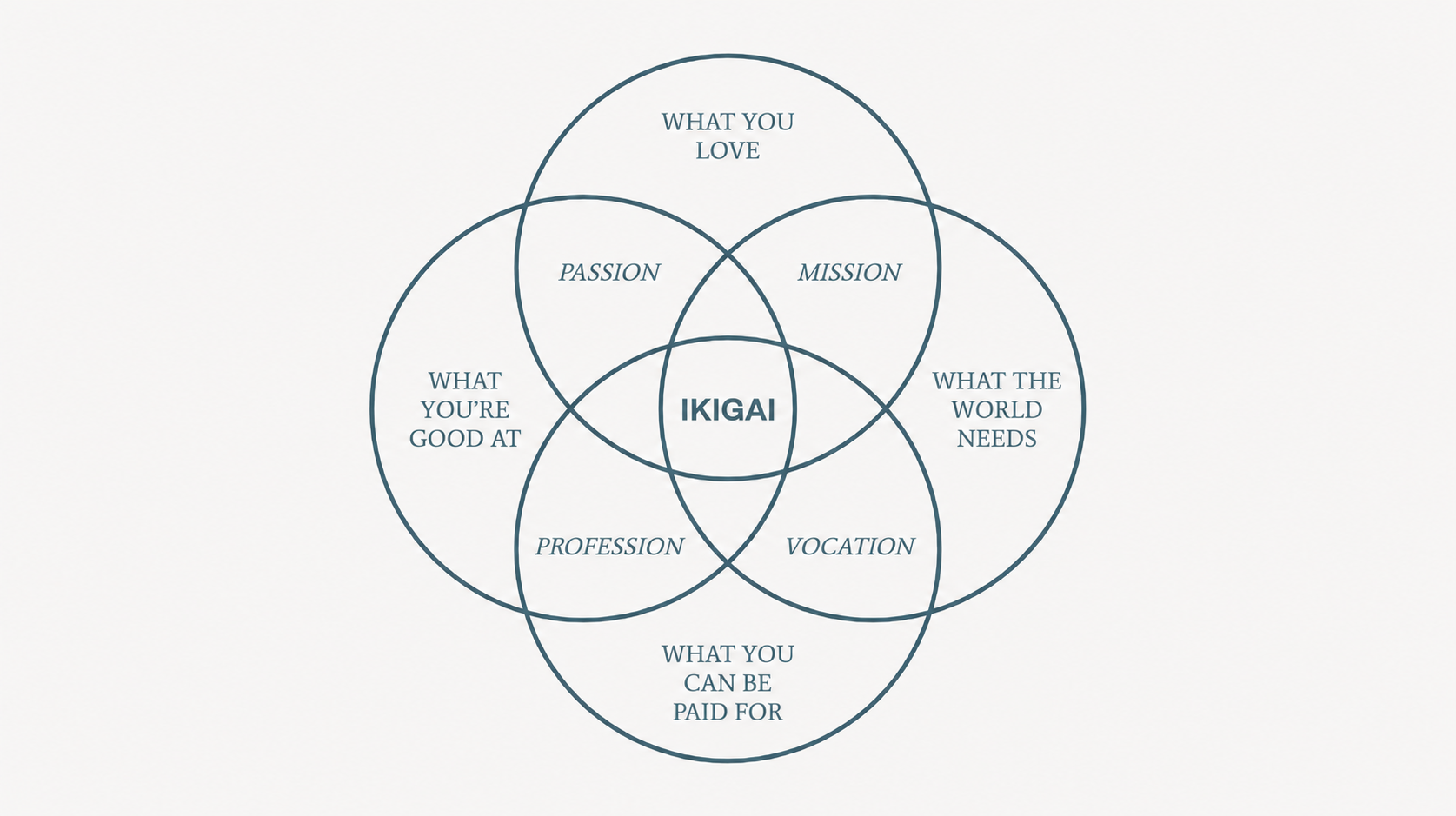
Try putting Kamiya’s child into the diagram.
The child does not need to be something you are good at. The world’s need for the child is beside the point, and getting paid for the relationship would make the example considerably stranger rather than more complete. Family is not an awkward exception to the model. The model was built to answer a different question.
Its history explains why. Andrés Zuzunaga created the four-circle diagram in 2011 as a representation of propósito—purpose—and it appeared in print the following year. In 2014, British entrepreneur Marc Winn encountered the Japanese idea of ikigai through Dan Buettner’s work on longevity and placed ikigai at the center of a version of Zuzunaga’s diagram.[3] The hybrid traveled exceptionally well. Its separate origins largely disappeared, and for a great many people the diagram itself became their introduction to the Japanese concept.
Zuzunaga’s four questions are not foolish questions. They are quite reasonable questions to ask about a working life. Winn’s adaptation is attractive for the same reason: it gives form to a real desire for work that is enjoyable, useful, sustainable, and suited to one’s abilities. The difficulty begins when that vocational puzzle is treated as though it were the concept Kamiya had been examining.
What the Diagram Leaves Out
Ikigai in Japanese writing and research has never settled into one equally tidy definition. Gordon Mathews used the phrase “that which most makes one’s life seem worth living,” broad enough to include work but also family, love, religion, creativity, and other forms of attachment and participation.[4] Other Japanese studies have worked with related ideas such as purpose, motivation for living, and the sense that life is worth continuing.[5]
A child can be an ikigai. So can work, friendship, a religious practice, a community, or some recurring activity whose importance would look trivial on a résumé. Human beings derive reasons for living from relationships and practices that do not share a common economic structure.
Consider what sustained care for another person can actually consist of. Breakfast has to happen. Medication has to be remembered. Clothes, transportation, appointments, conversation and reassurance recur whether anyone feels inspired that morning or not. Very little of that is illuminated by asking what the caregiver can be paid for.
The four-circle diagram took a broad account of what can make life worth living, recast it as a vocational puzzle, and then circulated widely enough that the puzzle itself became many people's introduction to ikigai. Once payment becomes one of the four gates to the center, unpaid care and relationship become awkward cases. The same happens to someone whose religious observance orders the week or a retiree whose usefulness has migrated from employment into family and community. None requires rescue by redefining compensation metaphorically. They expose the narrowness of the geometry.
That would be enough reason to be cautious about the diagram. Its more interesting weakness remains even if we temporarily accept all four circles on their own terms.
The Center Moves
What do you love? What are you good at? What does the world need? What can you be paid for? The diagram presents these as four existing sets whose intersection can be located through sufficiently careful reflection.
The trouble is that their contents change while we live.
People become good at things they were once bad at. They sometimes acquire affection for work that initially held only moderate interest. The needs they can recognize change with experience. Markets change as well, sometimes making a newly acquired skill valuable and sometimes making a long-established one less so. Even the question of what a person loves is partly shaped by participation, because mastery alters what an activity feels like from the inside.
A beginning woodworker and an experienced one can stand in front of the same router table and encounter different objects. The beginner sees a machine that cuts wood. The experienced worker may immediately notice that bit-height adjustment is awkward, that dust collection interferes with a particular operation, or that the supplied fence makes a common setup slower than it needs to be. Years of handling tools and materials have altered what is available to perception. The problems were physically present all along; the practitioner became capable of seeing them.
Relationships develop the same way, although the mechanism is different. Someone who eventually says that caring for grandchildren is among the central sources of meaning in her life could not have put that answer into a purpose diagram at twenty-two. The grandchildren did not exist. Neither did the later version of herself who had raised their parent, lived through the intervening decades, acquired particular habits of care, and become attached to a family structure that could only emerge through time. The source of meaning and the person capable of receiving it developed together.
This is where the diagram becomes much more useful retrospectively than prospectively. A craftsperson who has built a satisfying business may look backward and find all four circles occupied: the work is enjoyable, competence has accumulated, customers value the result, and money changes hands. The diagram describes the arrangement reasonably well once the arrangement exists. It tells us much less about how somebody who could not have filled in those circles twenty years earlier became that craftsperson.
The same temporal problem survives when work is removed completely. A religious practice can deepen through repetition rather than preceding it as a fully formed conviction. A neighborhood becomes a particular place partly because relationships and routines accumulate there. Meaning is often attached to history.
What Reflection Cannot Know Yet
This does not make introspection useless. Reflection can reveal values, aversions, curiosities, obligations, and constraints. Some people know early that they want a particular life and pursue it with remarkable consistency. A student who has wanted to practice medicine since childhood may indeed make a deliberate sequence of choices that carries that intention forward.
But reflection has an information problem. It cannot supply experience that has not yet occurred.
A prospective surgeon can learn anatomy, observe operations, talk with physicians, and think carefully about whether the profession fits. What cannot be known in advance is the perceptual world created by years of trained attention: which small variation matters, what resistance under an instrument means, when an ordinary-looking detail deserves another look, which parts of a situation can safely be ignored. Those distinctions belong partly to the competence that has not yet been acquired.[6] They are therefore unavailable to the person trying to solve the whole future from the starting position.
Meaningful work often develops through the same process. Someone enters a field because it is interesting, because circumstances make it available, or because it seems worth trying. Participation produces familiarity; familiarity can produce competence; competence makes previously invisible distinctions visible. Certain problems begin to attract disproportionate attention. Sometimes that accumulation becomes a craft, a specialty, a business, or a vocation. Sometimes it does not.
There is no guarantee built into participation. People become very good at work they do not find meaningful. Some environments are corrosive despite offering endless opportunities for mastery. A hobby can remain a hobby, which is not a lesser outcome. Learning more about a domain can reveal misalignment just as easily as it can produce attachment.
Money belongs in this account as a constraint rather than a definition. Payment is not required for something to function as ikigai, but material life places limits on what can be sustained. Rent continues its stubborn insistence on being paid while we contemplate the meaning of life. A person may perform meaningful work that cannot support a household, remain in acceptable paid work because it supports something meaningful elsewhere, or eventually find a form of work in which those parts of life overlap. The fact that money matters does not require putting it inside the definition.
What remains is less orderly than the four circles. Sources of meaning can be inherited or built, attached to work or located completely outside it, enduring for decades or important only during one period of a life. Several can coexist. None has to win a competition for the center.
When the Center Disappears
Kamiya’s harder question returns here. Sources of ikigai can be lost.[1]
Mathews emphasized the provisional nature of ikigai for much the same reason. Work ends. Children establish lives of their own. Bodies lose capacities. Relationships dissolve. Communities change or disappear. A life can be organized around something for decades and then find that its old organizing structure is no longer available.[7]
Seen from that direction, the static center becomes especially misleading. Even if a person could locate a perfect intersection at thirty-five, there is no reason to expect either the person or the surrounding world to preserve the same configuration at sixty-five. The question is not merely how one finds a source of meaning, but how sources form, change, coexist, and sometimes have to be rebuilt.
There is a cost to forgetting this. Someone spending years caring for a parent can look at the four circles and conclude that one of the most demanding and meaningful roles in a life somehow fails the test because it is unpaid. Someone beginning again at fifty can mistake the present inventory of competence for the boundary of what remains possible. A young person can keep searching for an option in which all four circles already overlap and interpret the absence of such an option as evidence that the right path has not yet appeared.
The alternative is not another diagram. The attraction of the four-circle version is understandable: it gives uncertainty edges and turns a developing life into a search problem with a visible solution. Ikigai is not waiting motionless at that intersection for us to find it. Whatever form it takes at a particular moment, we have usually had some part in becoming the person for whom it can matter.
Notes
[1] Mieko Kamiya, Ikigai ni Tsuite (On the Meaning of Life), Misuzu Shobo. The publisher records the original publication in 1966 and Kamiya’s service at Nagashima Aiseien from 1957 to 1972. Its description and table of contents show the book’s concern with what makes daily life worth living, the loss of ikigai through serious illness, bereavement, broken hopes, guilt and confrontation with death, and the discovery of new sources of ikigai.
[2] Kamiya’s distinction between the source or object of ikigai and the felt state of ikigai-kan is discussed in “Finding ikigai: How robots can support meaning in later life”, which cites Kamiya’s 1966 work. Kamiya’s own example—“this child is my ikigai”—is reproduced in “Ikigai Sources & Ikigai-Kan”.
[3] Andrés Zuzunaga describes the origin of his purpose diagram in “Tu propósito vital, único e irrepetible”. Marc Winn’s original 2014 essay, “What is your Ikigai?”, places ikigai at the intersection of the four questions and links his interest in the concept to Dan Buettner’s longevity work. Winn has since added a note acknowledging that the underlying purpose diagram was Zuzunaga’s and that his own contribution was placing ikigai at its center.
[4] Gordon Mathews, What Makes Life Worth Living? How Japanese and Americans Make Sense of Their Worlds, University of California Press, 1996. Mathews describes ikigai as “that which most makes one’s life seem worth living” and examines its expression through work, family, love, religion, creativity and self-realization.
[5] For the range of concepts used in research on ikigai, see “Finding ikigai: How robots can support meaning in later life”, which surveys Japanese and international research associating ikigai with meaning in life, well-being, self-realization, and day-to-day joy, as well as the distinction between sources of ikigai and ikigai-kan.
[6] Experimental research supports the narrower claim that surgical expertise changes what practitioners can extract from perceptual and haptic information. In “Effects of experience on force perception threshold in minimally invasive surgery”, experienced surgeons detected simulated tissue contact more quickly than novices. “Simulator-Based Assessment of Haptic Surgical Skill: A Comparative Study” found measurable differences between experienced surgeons and novices in force reproduction, while research on critical operative events has found deeper comprehension of the operative field and richer anticipation among experienced surgeons. These studies support the example’s general point about trained perception; they do not imply that every specific cue named in the paragraph has been independently demonstrated.
[7] Mathews treats ikigai as provisional rather than a final solved state: sources of meaning can be disrupted by retirement, loss of work, changing relationships, children leaving, fading dreams, and ultimately death. See the introduction to What Makes Life Worth Living?.
© 2026 Joel Schwarzbart. All rights reserved.